Tuesday, February 14, 2012

Rothko's Red over Black or Black over Red?

The Phillips Collection has an intimate Rothko Room which
creates a meditative space to view his color field paintings. The
museum's founder designed the room specifically for this purpose.

Mark Rothko's last years are chronicled in a play currently showing at the Arena Stage in Washington,DC. Washington holds a special place for this artist, with the National Gallery holding the largest collection of his work in the world and the Phillips Collection having a special Rothko Room designed for his work by the museum's founder.

"Red," an award-winning Broadway play by John Logan, will continue its run until March 9. The entire play takes place in Rothko's studio with a dialogue between Rothko and a young assistant named Ken. In 100 minutes without interruption, there are no lulls in this play.
Of Rothko, Duncan Phillips described "mysterious layers of paint...suggest depth in spite of their flat mat quality." Orange and Red on Red, 1957, is part of
the Phillips Collection.

The discussion of color illuminates meaning in Rothko's paintings. Rothko refers to Matisse's The Red Studio of 1911, a seminal work of 20th century art. Red is a life force, a vibrancy and the fire of creativity. But the color black diminishes that life force. Rothko explains in the play: "The only thing I fear in life is that one day the black will swallow the red."

Through the dialogue, a strong, artistic character emerges. Rothko is both very moralistic and egotistical. He is an artist who wants success but has doubts about selling out to commercialism. He is kind and generous, but selfish and critical of his assistant. We can compare these diverging qualities of his character to his paintings, where he portrays shifting emotions felt in life and in nature, perhaps attempting to mend the divisions within himself.
The National Gallery of Art is having a special showing in the East Wing of some of the paintings
for the Seagram Mura
l project during the run of "Red" on Arena Stage. Gift of The Mark Rothko Foundation, Inc. Copyright © 1997 Christopher Rothko and Kate Rothko Prizel
Edward Gero gives a credible interpretation of this giant of the 20th century, a color field painter. Patrick Andrews is the artist's assistant. The play's action takes place when the painter was working on a series of murals for the new Four Seasons restaurant in New York's Seagram Building, a major monument of modern architecture designed by Mies van der Rohe and Philip Johnson. It is not necessary to know Rothko or understand art to enjoy the play!

Mark Rothko, no 12, 1960, is an oil in Museum of Contemporary Art, Los Angeles

Dialogue in the play gives insight into the thought process of this enigmatic artist and the ebb and flow of 20th century art movements. The artist discusses Jackson Pollock and explains his drunk-driving death as a suicide. Rothko describes his fellow Abstract Expressions as the children of Cubism, with these artists admiring the father (Picasso) but killing off their father. Rothko, a philosophical thinker of considerable spiritual depth, disparages the flash of Andy Warhol. He acknowledges that Pop Art is eclipsing the Abstract Expressionists, which also means that, at that time, the children are killing off their fathers.

In the end, the black swallowed red, unfortunately.

Sunday, February 5, 2012

Mourners are Something to Cry About


An exquisite of exhibition "mourning" statues at the Virginia Museum of Fine Arts, Richmond, have a beauty and realism that give us something to cry about, a phrase Michelangelo used to describe Flemish painting.

In the 15th century, Flanders was ruled by the Duke of Burgundy and similarities to the Flemish style of painting can be are apparent in the style of sculptors Jean de la Huerta and Antoine de la Moiturier. They learned their art from the great Claus Sluter, a Netherlandish sculptor who worked in Burgundy. The Dukes of Burgundy had one of Europe's richest courts, in rivalry with the King of France to the west and Holy Roman Empire to the east.

The 40 statues line up as if in a funeral procession. At the exhibition, viewers have a chance to see the statues in more completeness and in a more realistic way than in the location they were originally placed, below the bodies of Duke John the Fearless (Jean sans Peur) and his wife, Marguerite. In the current display, the alabaster figures are seen as they move in space, without the elaborate decorative Gothic frames that confine them. They represent the clergy and family members who had been part of Jean the Fearless' funeral procession in 1424. The statues are on loan from Dijon, France, while the Musee des Beaux Art is undergoing renovation.
Cowls and hoods identify these figures as mourners in the funeral procession. They are alabaster white with details such as books and belts painted. Larger effigies of the duke and duchess were painted in bright colors to look real.
Like Rogier van Weyden or the Master of Dreux Budé , these sculptors drew on both realism and emotionalism in a style that is on the cusp between the late Middle Ages and the Renaissance. The figures are white with a few painted color details, although mourners and even horses, in the funerary procession actually wore black, hooded robes. A tomb of Philippe Pot, Seneschal of Burgundy, from about 1480 has life-size, hooded black figures which hold up the tomb and give an even more realistic version of a funeral.

Life-sized, hooded, black pallbearers were carved anonymously c. 1480 for the tomb of Philippe Pot, Seneschal of Burgundy. They have a greater sense of actuality but less individual, emotional pathos of the group in traveling exhibition.
The small white, alabaster figures, however, are full of passionate emotion, and they move into a a variety of different positions. Their angular cuts of drapery are Gothic in style, but when seen in the round, as on display now, the statues have a 3-dimensional spatial conception of the Renaissance. Fortunately the artists carved them in the round, even though they are not seen this way in the Gothic niches underneath the life-sized, reclining duke and duchess. (In 1793, French revolutionaries damaged the effigies of the duke and duchess who represented the repression of the aristocracy, but left the mourners largely unharmed.)
The statuettes are part of the funerary sarcophagus of Jean sans Peur and Marguerite of Bavaria in the fine arts museum of Dijon. The small mourners walk in a funerary procession but are covered by gothic canopies.

These figures call to mind all the mourning figure in art history who accompany the processions and burials of important historical people, and remind us of the processions like those of Roman emperors. Certainly "mourners" were part of the history of art going back more than 5,000 years. However, I couldn't think of any mourners from early Medieval art because the Early Christians felt death as triumphant and not a matter of earthly pain.

Although the Burgundian court was probably aware of ancient Roman sarcophagii depicting mourners in the funerary procession, the classical Greek-style Sarcophagus of the Mourning Women has a comparable format. This coffin of c. 350 BC was for a king of Sidon, Lebanon, and the women on bottom were probably part of his harem. Each mourner is carved in relief, standing separately between half-columns, while a chariots travel in a frieze above, perhaps the funerary procession or the rulers trip into afterlife. The women twist and turn and cry to show their various expressions of grief after the death of a leader. As usual, these mourners serve a god-like ruler, not ordinary citizens.

Eighteen women adorn the bottom of a sarcophagus of c. 350 BC, on
view at that archeological museum in Istanbul


Early Greek funerary art attempts to show profound emotion. Both the ancient Greeks and Egyptians had elaborate burial ceremonies for their heroes or rulers that could last weeks or months. Mourners accompany pharoahs in their tombs, as the women below.


To the right, female "professional" mourners with raised arms who accompanied the great Ramses in his funerary procession are painted in his tomb. 


Detail from a Greek vase in the Metropolitan Museum of Art has rows of mourning figures on either side of the funerary bier. Similar vases come from a cemetery in Athens and they date to 800-700 BC.

The lives of fallen Greek heroes were celebrated with elaborate games, chariot races and processions, as in the funeral sponsored by Achilles for the death of his friend Patrokles. Geometric style vases, from the 8th century BC, are decorated with scenes from funeral procession. Schematic, stick-like figures raise their arms to show they are grieving for the deceased.   The figural design is a composite type: frontal torso, profile face and a single, huge eye.

Even older than Greek and Egyptian representations are two small terra cotta statues from Cernavoda, Romania, c. 4,000 BC. Found in a burial close to the Danube River, these statues could be mourning figures. The man's arms are raised while the woman's arm is on her knee, her shape suggesting fertility and hope for continuity. I can't help but think these little figurines were made by the ancestors of Mycenaean or Dorian Greeks who in a later era migrated down into Greece.
The male figure is sometimes called "The Thinker," but these clay figures from Cernavoda, Romania may be mourners who accompany an important person in burial. The raised arms to show grief was later used by Greeks. They also remind me of Brancusi and Henry Moore.

The exhibition stays until April 15 in Richmond, the last destination in a 2-year, 7-city tour in the United States, including the New York Metropolitan Museum. Next they will go to the Cluny Museum on Paris before returning home. It will be interesting to see how they are displayed when they go home to Dijon.


Sunday, January 8, 2012

The Gentler Side of Caravaggio

Saint Francis in Ecstasy, from the Wadsworth Atheneum in Hartford, CT, is in the Kimbell Art Museum's exhibition, Caravaggio and His Followers until January 8
One painting in the Kimbell Art Museum's Caravaggio exhibition (today is the last day) reveals an unexpected side of Caravaggio's nature. St. Francis in Ecstasy, from the Wadsworth Athenaeum in Hartford, CT, is poetic. Parallel lines of light on water to the left lead to a very sweet angel holding St. Francis.  The saint  has swooned after receiving the stigmata, the wounds of Jesus. In dead center, St. Francis's foreshortened hand vaguely reveals this hole representing the nail that went into Christ's hand.

Intentionally I have refrained from writing about the type of paintings for which Caravaggio is most famous. The Boy Bitten by a Lizard and The Sacrifice of Isaac (in the Kimbell exhibition) cause discomfort and hit us in the gut. As Isaac is about to be killed by his father Abraham, he looks out of the painting and appeals to the viewers. We feel the boy's fear, but an angel rushes in to stop the father from killing him. Saint Francis is a much gentler vision, but like the other paintings, it concentrates on a crucial, transitional moment.

It is amazing that such a different sentiment can come from the same man who painted both joy and extreme pain, much like the extremes of his own life.

Detail of The Sacrifice of Isaac:
Caravaggio's Isaac calls out for sympathy. We feel his fear and pain

Monday, December 5, 2011

Caravaggio and the Moment of Mary Magdalen


Martha and Mary Magdalene, c. 1598, shows the saint at the moment of her conversion. It is from the Detroit Institute of Arts, but is currently on view in Caravaggio and His Followers, at the Kimbell Museum of Art
In Caravaggio's remarkable version of the Mary Magdalen story, he painted the moment of her transition from sinner to saint. As much as Dan Brown's The Da Vinci Code popularized the idea that the Church demonized Mary Magdalen, more commonly she was idealized in art as a saint who turned her life around. The painter Michelangelo Merisi, who is nicknamed Caravaggio, was demonized in his lifetime for his shockingly realistic paintings and his own "sinful" life. (He was charged with murder and often on the run.)
The inclusion of Martha with Mary Magdalen and other objects requires the viewer to interpret the symbolism. Martha is seated with her back to the viewer, with only one shoulder and her hands hit by Caravaggio's dramatic lighting. On the table are a comb, powder puff and mirror, symbols of vanity. Mary points to her chest holding a flower, while her other hand points emphatically to a diamond square of radiant light on the edge of the convex mirror.

The naturalistic light, seemingly projected from a window, is also a divine light, the ray of God which has inspired the worldly Mary Magdalen to "see the light." In the moment that Caravaggio highlighted and caught in paint, as if on camera, we witness spiritual transition. From this point on she will give up her luxury and prostitution to follow Jesus. By using models who resemble contemporary people in Rome, rather than Biblical characters, the viewers were supposed to identify with the personal nature of the conversion process.

Light is concentrated in a few important places: Martha's hands, Mary's face and chest, the hand and patch of light on the mirror. Sister Martha's hands are lit because she is pleading for Mary to change (and perhaps counting her sins and/or the reasons she should convert). Mary answers by pointing precisely to that light on the mirror.

Perhaps because Mary Magdalen was seen as an instrument of change, and as the most loyal companion of Jesus in his death, she was greatly idolized in the Middle Ages.
The church of Sainte-Madeleine, Vezelay, in Burgundy, was a site of her relics and one of the most important of all pilgrimage churches. However, in the late 13th century, a 3rd century Christian tomb discovered in the crypt of a church in Provence was connected to Mary Magdalen. The site of her devotion then moved to this church and another site in the delta of the Rhone, where legend claimed she had relocated after Jesus' death.

After seeing Caravaggio's painting of Mary Magdalen, I thought differently of Georges de la Tour's The Penitent Magdalen at the National Gallery. Like Caravaggio, he used a contemporary young woman as his model. Yet this contemplative scene omits symbols of vanity and the light-dark contrast comes from candlelight hidden behind a skull. As Mary looks in the mirror, the skull is reflected rather than her face, as de la Tour has artfully manipulated perspective. Lif
e as a sinner leads to a spiritual death. Death is inevitable, but if she chooses to follow Jesus she will die of the self and be reborn in new life.

Here Mary Magdalen may either be ponderin
g her fate before conversion, or thinking of her wish to be reunited with Jesus in eternity later in life. Oddly, she caresses the skull as if wanting to die, perhaps because death for a person at peace with God is ultimate goal and preferable to life on earth. The shape of the skull mimics, in reverse, the shape of her sleeve, arm and hand, showing her intimate connection to thoughts of death. In his view, we are also encouraged to ponder our actions and/or sins and consider our life in eternity. Personal faith is in important factor of both the Reformation and Counter-Reformation at this time, although only the Catholic artists would portray saints. De la Tour leaves the meaning ambiguous, unlike Caravaggio who shows a transitional moment.

Georges de la Tour, The Repentant Magdalene, c. 1635, at the National Gallery of Art, Washington, shows her in a contemplative mode, perhaps thinking of death.

In the 6th century, Pope Gregory gave a sermon suggesting Mary Magdalen had been a prostitute before following Jesus. (Of her past, the Bible refers to the seven demons Jesus cast out of her, a vague description.) Although the church usually portrayed her to show that salvation is possible to all who ask for forgiveness, the model for Caravaggio's Mary Magdalen was Fillide Melandroni, one of Rome's most notorious courtesans. Neither she nor Caravaggio--who revolutionized art in his time--seem to have undergone a spiritual revolution. Caravaggio was frequently in fights and in 1606 he appears to have gotten into a fight with another man over Fillide, this remarkable woman.

(Note: Caravaggio's more famous paintings of religious calling/conversion are The Calling of St. Matthew and The Conversion of St. Paul, both in Rome and done around 1601. This artist's life is always a fascination to the public. There is a new biography about him by Andrew Graham-Dixon, Caravaggio: A Life Sacred and Profane, which may try to explain the contradictions of his life. A biography I read a long time ago is Desmond Seward, Caravaggio: A Passionate Life.)


Sunday, November 27, 2011

Paintings of Deception

Valentin de Boulogne, Soldiers Playing Cards and Dice, c. 1618/20

A magnificent exhibition of Caravaggio and His Followers at the Kimbell Museum in Fort Wort
h features the Washington National Gallery of Art's Soldiers Playing Cards and Dice by Valentin de Boulogne. The painting tells a story of deception. Caravaggio had also painted Card Sharks with fewer figures. Boulogne, a Frenchman working in Rome, may have known of his composition.

Boulogne's painting is a tight, close-up composition with masterfully chosen areas of ligh
t. Two simultaneous episodes are taking place: dice throwing on the right and cheating card players on the left. The card sharks are the first to demand our attention, as they look startlingly real. Behind the central figure, who is in the process of cheating, another drama is happening. A man on the right looks down and covers his dice, perhaps hiding something while his adversary with the red hat seems about to erupt in anger. Although not a traditionally religious painting, Boulogne suggests two of the deadly sins, deception and anger. He warns of the hazards of gambling, exactly what these two vignettes represent.

The dice player with downcast eyes can be variously interpreted.

The sinister scene is set in a dark room. The well-dressed young man in front left is being duped by two soldiers, while two men cross behind them playing dice. The compact composition and the forceful use of diagonals heighten the tension, connecting the men who otherwise would be seen as individual character types. Colors are primarily earthy for these ruffians. But other colors fight for attention: white, scattered touches of blue clothes and the brilliant red hat in center (symbol of anger?), which is replicated in less vibrant red stockings on bottom facing the other direction.

A dark, sinister man in the upper left corner startles with his realistic presence. The details of faces come from a blog, Head for Art, May 24, 2010.

Eye movements and gestures pull us around the painting. At first glance, I am attracted to the white face and dark staring eye of the man in center (see below). His gaze goes past his competitor, to the man in shadow behind. Though the face of this man on the far left is darker than the others, his expression is so real as his fingers signal the number two (above). The shadowy compositions suggest that more than cheating is going on, something very dark, sinister and deceptive. Boulogne warns against taking chances in life. Intense light- dark contrast is a legacy of Caravaggio.

Viewers note the intensity of this soldier's stare and his slow, careful choice of cards pulls the viewer into the story.
 

Caravaggio, The Fortune Teller, of 1594, comes from the Capitoline Museum of Rome. The aristocratic young man falls in love as he is being duped.

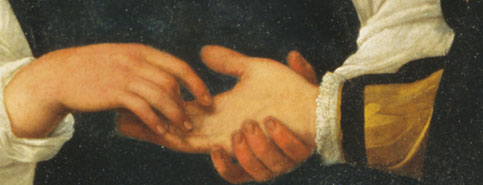
Another allegory of deception Caravaggio painted is The Fortune Teller, 1594, a startlingly realistic depiction in the Kimbell's exhibition. An alluring young gypsy and fashionable aristocrat look at each other with an intense hold. Her face suggests she is attracted to him, or at least feigning an attraction. His puffed sleeve, puffed cheek, elbow, sway of hips and sword express confidence, but caution is thrown to the wind. As the girl reads his palm, she slyly slips off his golden ring. The viewer, captivated by the couple's loving gaze and beautiful clothing, is also tricked. We only see this detail by close inspection. The colors are primarily earth tones, black and white.


The Cheat with the Ace of Clubs, by Georges de la Tour, 1630-34. The cheat, who slyly looks at us and shows his deck, is a "shady" figure, both literally and figuratively.  The shadiness of the story is in contrast to the highly polished figures and their clothes.

Georges de la Tour's scene of card players, in the Kimbell's own collection, rounds out these tales of deception. Some elements of The Cheat with the Ace of Clubs are familiar-- its close-up view and dark background. But the colors are brilliant oranges, pinks and reds. The youngest boy will get duped, and everyone else knows they are taking advantage of him. Cheating begins with the large woman who glances sideways at the woman bringing wine, who in turn casts one eye towards the "shady" cardplayer. In shadow on the left, he holds out the cards for us to see and looks at us outside the painting, bringing the viewers into the drama. The boy on right is innocent, but flirting with a world beyond his experience. The background is completely black behind the evil threesome, while the young boy is still halfway "in the light" of the painting, midway between good and bad. He can choose to stay on the right side, both literally and figuratively.
 

Certain Baroque painters could visually portray situations comparable to the dramatizations of Shakespeare from the 1590s and early 1600s. Carefully calculated figure placements and compositional angles let the human drama unfold before our eyes. They moralize and forewarn viewers of evil. Caravaggio's Fortune Teller and de la Tour's Cheat with the Ace of Clubs also are also comedies, because the well-dressed young men, possibly aristocrats, do not realize their susceptibility to trickery.

Wednesday, November 23, 2011

From the Childhood of Michelangelo


St Anthony Torment by the Demons, c. 1487, was painted by Michelangelo when he was only 13. The panel, 18 x 12 inches, is warped as happens to many panels over time.

The Torment of Saint Anthony is a small panel painting which was recently discovered to have been painted by Michelangelo in 1487/88. Intensive cleaning in 2008/9 led experts to believe that Michelangelo painted it when he was 12 or 13 years of age. Only four easel paintings by Michelangelo are known, and this one of is in North America, at Fort Worth's Kimbell Art Museum.

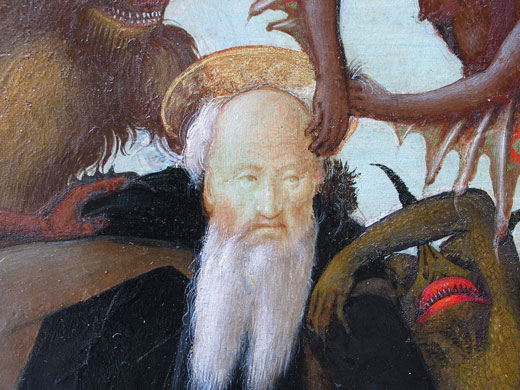
Michelangelo's St. Anthony looks remarkably calm despite the demons who are scratching him

St. Anthony was an early Christian of the 4th century who lived as a hermit for many years. According to his biographer, the rigorous asceticism practiced by St Anthony in the Egyptian desert allowed him to float in the air, where he was attacked by devils trying to beat him to the ground. Anthony defeated these demons on more than one occasion, but not without a big struggle. It is not at all surprising that a young Michelangelo would have been attracted to this subject, because the artist always seemed to be battling his own internal demons, as the poetry he wrote and certain sculptures of slaves he made later in life would suggest.


Schongauer's masterly engraving, St. Anthony Tormented by Demons, c. 1480, gave inspiration to the young Michelangelo
Michelangelo copied an engraving by a French-German artist, Martin Schongauer, who was Europe's greatest practitioner of printmaking at that time. Schongauer used a vivid imagination and great technical ability to show light, shadow and texture. These beasts are composite creatures of fanciful reptiles, fish and flying monsters, who scratch, pull and club the holy man. Schongauer left the landscape minimal, a small edge of rocks in the lower right-hand corner which describe the mountain he lived on in isolation. Saint Anthony seems to be suspended in the air, in a radiating, circular composition. Schongauer used short dots or stipples to get his deepest shadows into the small metal plate used for engraving.

We don't know the date of Schongauer's engraving--perhaps about 1480--but we know that his prints traveled throughout Europe. Michelangelo's biographers said that he made a painting after a Schongauer print when he was 13, and this new attribution fulfills that void in our knowledge. This connection also shows the important role of prints in spreading artistic ideas and iconography, with the engraving passed into Italy from Germany.I have seen the Schongauer original in the print room of the National Gallery and its details are incredible. No wonder the young genius was impressed.

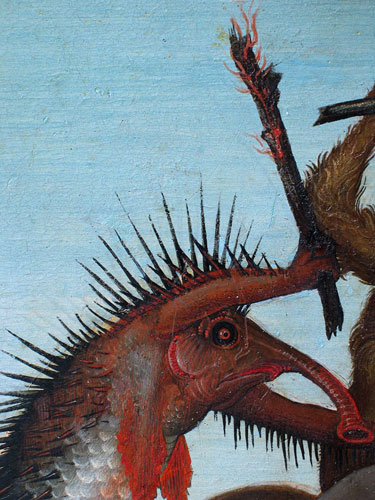
Although Michelangelo borrowed many details
from the great German engraver, he went to
the fish market to observe. According to the
Kimball Art Museum, Michelangelo scraped away
lines of paint in the body of the fish-like creature,
revealing the primer beneath the paint in the
parallel lines of hatching.

When Michelangelo copied Schongauer, he was equally adept at detail. He straightened Saint Anthony's head, gave him a shorter beard and added an interesting landscape background. The brown-gray foreground is rocky and craggy, and in pristine detail. Critics of the Michelangelo attribution do not like the background. The painting has a high viewpoint just like St. Anthony who lived on a mountain near the Nile when the demons attacked and lifted him. So this landscape is a bird's eye view of river, hills and sky with a low horizon line. Using aerial perspective, it gets more and more indistinct as it goes back into space and turns nearly white as it hits the horizon. The cool colors of the background and the low horizon line allow the figures to come forward and stand out with warm colors. This setting may be more reminiscent of the Arno in Florence than the Nile River, but European artists of the time were not familiar with the desert.

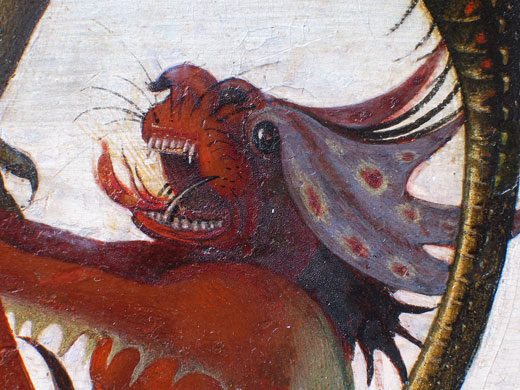
Photos above and right were taken by the Kimball to AP. This demon was painted in tempera and oil with magnificent detail. Color changes and the meticulous line technique are visible.
His mouth is ferocious.