Monday, August 20, 2012

Celebrating African-American Art and Life in the 20th century


Sam Gilliam, The Petition, 1990, mixed media

Smithsonian American Art Museum's exhibition, African American Art: Harlem Renaissance, the Civil Rights Era and Beyond gives a broad overview of 43 artists whose work spanned 8 decades of the 20th century.  Over 40 photographs, as well as paintings, give a provocative picture of urban and rural life during the Depression, the age of segregation and the Civil Rights and later.  Although there is some overlap with other 20th century art movements, the exhibition is mainly art focused on African-Americans and their lives.  Both abstract and figural paintings are included, but also sculpture by Richard Hunt, Sam Gilliam, an important recent figure in the art scene of Washington, DC.   The artists come from the South and North, with a large number from urban areas of Detroit, New York, St. Louis, Baltimore and Washington, DC.

Detroit artist Tony Gleaton recorded his travels to Nicaraguain in Family of the Sea, 1988,  from the series Tengo Casi 500 Anos: Africa's Legacy in Central America, above.   Roy De Carava was a New Yorker whose photos capture aspects of city life  as in Two Women Manikan's Hand, 1950, printed  1982, on right.  (gelatin silver prints)

The portraits give impressive concentrated views of individual personalities, particularly by Tony Gleaton and Earlie Hudnall, Jr. I especially liked the photographs of Ray DeCarava, for the artistic compositions with interesting value contrasts. Although the portrait photography is very interesting, I'm partial to DeCarava's staged compositions which look like film stills.

Ray DeCarava, Lingerie, New York, 1950, printed 1982, gelatin silver print, left.

Gleaton's works are part of series photos, such as Africa's legacy in Central America.   But there is also a series from the WPA (Works Project Administration of the 1930s, part of the New Deal.   Robert McNeill 's several photographs include those from his project entitled, The Negro in Virginia which has both interesting portraits and slices of life.  The art of photojournalism really began at this time, during the 1930s.

The contrast of black and white photography works well exhibited next to bold, colorful works of art by the Harlem Renaissance artists, such as Jacob Lawrence and Romare Bearden, who worked with collages.  Bearden, Lawrence, as well as Lois Mailou Jones and Norman Lewis, are among the most important painters who contributed to the artistic life of Harlem in the 20s and 30s.  The Harlem Renaissance also produced writers, musicians and poets such as Langston Hughes. 


Community, by Jacob Lawrence is a gouache of 1986.
It is a study for the mural of the same name in Jamaica, New York

Lawrence lived until 2000 and spent his last 30 years as a professor at the University of Washingon in Seattle.  The exhibition has both an early and a late work.   Lawrence maintained a similar style in the   later work, always influenced by colors in Harlem which he said inspired him.  Lawrence's most famous works are the series paintings, The Migration Series, half of which is in Washington's Phillips collection, and the Harriet Tubman series and the Frederick Douglas series at the Hampton University in Hampton, Virginia, where another large collection of African-American art is kept.

Charles Searles' Celebration is an acrylic study for a mural painting
in the William H Green Building, Philadelphia, made in 1975


Charles Searles was from Philadelphia and the Smithsonian's Celebration is actually a study for a mural done in the William H Green Federal Building in Philadelphia.   Likewise, Community is a study for a mural Lawrence did in Jamaica, New York, 1986.  It evokes a spirit of togetherness and cooperation.


Norman Lewis, Evening Rendezvous, 1962

Abstract works may actually be visualizations with other meanings.  Norman Lewis's Evening Rendezvous of 1962, is an abstract medley of red white and blue, but the white refers to hoods of the KluKluxKlan and red to fires and burnings.  Not all is innocent fun, but Enchanted Rider, done by Bob Thompson in 1961 is more optimistic.  The rider may actually be a vision of St. George who triumphed over evil and is a traditional symbol of Christian art.

Enchanted Rider by Bob Thompson, 1961

Though the exhibition is somewhat historical, it wants the viewer to judge each piece on its own merit, and to see it as a unique expression of the individual artists.  There is not a heavy emphasis on chronology or history.   Lois Mailou Jones is one such personal, but symbolic artist who picked up ideas from living in Haiti and traveling to 11 African countries.  In Moon Masque, 1971, pattern, fabric design and African rituals are evoked.  I like the color in most of these paintings and the celebration of life so vividly expressed in these works.

Lois Mailou Jones, Moon Masque, 1971

The Smithsonian American Art Museum has the largest collection of African-American Art in any one location, but this exhibition is only a portion of their collection.  Some modern masters, such as Elizabeth Catlett, Faith Ringgold and Perry James Marshall, are not included in this showing.  After the exhibition closes in Washington September 3, it will travel to museums in Williamsburg, Orlando, Salem, MA, Albuquerque, Chattanooga, Sacramento and Syracuse for the next 2-1/2 years.


Wednesday, August 1, 2012

The Magic or Remedios Varo


Since going to the Miró exhibition recently, I've been reminded of Remedios Varo.  In 2000, I discovered this marvelous Surrealist in an exhibition devoted to her at Chicago's Mexican Fine Arts Museum. Called The Magic or Remedios Varo, the exhibition had been organized by Washington's National Museum of Women in the Arts and shown there. At the moment of this writing there is an exhibition at Mexico City's Museo de Arte Moderne de Mexico, entitled Remedios Varo: 50 Keys.  It includes 50 works of art and a single sculpture.

Certainly Frida Kahlo is much better known, but I find Varo, who knew both Kahlo and Diego Rivera, more evocative and interesting as an artist. Varo also uses a female subject as her chief descriptive vehicle, but she is less self-absorbed than Kahlo and more concerned with the larger world.

Varo was a Surrealist born in Spain in 1908, but exiled to Mexico after 1941. Like Gaudi, Miró and Dalí, she was Catalan, originally from Angles, near Girona and close to the French border.  Some of the literature I read of her suggested she was a scientist with a dedication to nature close to that of Leonardo da Vinci. She learned much through her father, an engineer, and lived part of her childhood in Morocco. Varo is certainly a detail artist and paints more in the style of a tempera painter than an oil painter. Yet I hardly see a deep devotion to science; her art taps into more of a spiritual quest for understanding the world.  Perhaps, to other observers, she bridges the gap between science and the mystical.

Varo's people are tall and thin, elongated like Sienese or Catalan figures from around 1400.   Her perspective is also similar, somewhat long and exaggerated, also. She has a delicate touch and is able to find connections unexpectedly.  As a woman spins in The Alchemist, above, the checkerboard of her cloak turns into tile patten of the floor  beneath her.  Or is it opposite?  She could be weaving the tile floor into her clothing.  Some kind of contraption behind her is the machinery that connecting what's inside with the outdoors.  The perspective is like Sienese artist Giovanni di Paolo.

Throughout her work I'm reminded of creativity, where it comes from and where it goes.  Her artwork evokes these connections again and again.  There something mystical in how it comes about.  While The Flutist, above, plays next to a mountain, the stones magically rise and form a tower, while a schematic mathematical drawing holds the tower in place.  Stairs of the tower are rising, going up to heaven like a Tower of Babel.  However, some sources cite the the periodic table of chemistry, though I don't quite see that connection.   There are fossils on these stones, so a connection to the ancient past, present and future come together in one place.
Creation of the Birds, left, dates to 1957.  As a wise woman in owl's clothing paints birds, the birds fly out the window, She also holds a magnifying glass lit by a star out the window which, in turn, illuminates her creation.   The brush comes out in her center, the heart source of creativity, which is really a guitar strung around her neck.  There are egg-shaped contraptions on the floor and out another window.  In fact, this machine mixes her paint, while a bird eats on the floor.  Art, music, inspiration, heart, mind, and inspiration flow together, while birds fly in and out.  The artist's work is to connect inner and outer worlds.

Varo's connection to Surrealists in Paris and Barcelona was strong.  She attended the Academy of San Fernando in Madrid, the same art school as Salvador Dalí had attended. We know little of her work in Europe before she went to Mexico, but we know she admired the paintings of Heironymous Bosch at the Prado and philosophical writings of the hermetic tradition.  Most of the work that can be seen is comes from the 1950s up to her death in 1963.  Her association with the Surrealism made her unacceptable to either the Spanish government after the Civil War or a France during Nazi occupation.  She and her French husband fled to Mexico where they met other artists such as English-born Leonora Carrington, perhaps the artist closest to her in style.

We can't always know what was on her mind, as in the case of much Surrealism, but there seems to be a desire to tap into the origin of creativity and to connect the self (herself) to the larger universe.  Her last painting, before she unexpectedly died of a heart attack at age 53, was Revolving Still Life.   Pieces of fruit spin off plates as the planets orbit the sun. How interesting the many ways she can connect the small and ordinary with the big, cosmic implications!  She has many online followers and fans of her work.  There was an exhibition in Los Angeles last Spring which featured 10 of her paintings.

Tuesday, July 24, 2012

Miró: Ladders of Escape


Joan Miró, Nocturne, 1935, is a small oil on copper
from the Cleveland Museum of Art.  A jumping man,
crescent moon and spiral suggest the artist ability to
leap above problems of life.


"We Catalans believe you must always plant your feet firmly on the ground if you want to be able to jump into the air"


In 1948, Joan Miró used these words to describe the Catalan mentality.  Like Salvador Dali and Antoni Gaudí, giants of modern art and architecture, Miro came from Catalonia, the area of Spain on the Mediterranean Sea near the French border.  Catalans had a language and cultural identify different from the rest of Spain. Washington's National Gallery, which hosts a Miro exhibition until August 12, completes the quote on a wall label:

 "The that I came down to earth from time to time makes it possible for me to jump higher."


Joan Miró: Ladders of Escape is the appropriate name for this exhibition which captures the flying spirit of this Surrealist artist.  From beginning to end, the exhibit relates him the times and places he lived. His lifespan was long, from 1893 until 1983. As the world changed so much during the the 20th century, politically, artistically and technologically, his art also changed but kept some continuities.

Vegetable Garden and Donkey, Moderna Museet, Stockholm,
1918, reveals Miro's roots
Miró's family had a farm in the country town called  Montruig, "red mount" in Catalan.  The earliest paintings show his roots in an agricultural land which launched him.  Some of the animals, particularly the rooster, will recur in his art, after he moved to Paris in 1920.

The National Gallery of Art's large painting called The Farm, 1921-23, in a style at times called detailism, shows a compulsive need to fill up the painting. Miro considered it autobiographical and Ernest Hemingway, who owned it, thought it represented both the artist and Spain in the midst of change. Meticulous and precise, The Farm has two ladders, 4 rabbits, 2 roosters, other birds and crops, buildings and a tree in the center.  There is "earthiness" on the ground, but the animals are perched on top of various launching pads; In this painting, we witness a Miró who is ready take off as an artist. 


By the time Miró painted the National Gallery's The Farm, 1921-23, his art began to change.   Shown above is a detail of the painting has farm animals and other symbols such as the ladder which will remain  most of his life. 

in 1923, he joined the Surrealist group of artists led by André Breton. He adopted a biomorphic Surrealism which is more abstract than realistic. He began to use repetitious motifs, such as a "Catalan Peasant," ladders, roosters. Surrealism put the subconscious mind on equal par with the conscious mind and Miró's images appear as symbols. A painting of 1926, Dog Barking at the Moon, gives insight into Miró's thinking.  If the barking dog is chasing the moon, his dreams, the ladder suggests a way to get there.  
Joan Miro, Dog Barking at the Moon, 1926, is from the Philadelphia
Museum of Art is an early example of his Surrealism.
During this time in Paris, Miró was working with free association.  He even said, "Rather than setting out to paint something, I begin painting.........and the paint begins to assert itself."  In style and in working methods, we can also associate him with Antoni Gaudí, who was constantly revising and changing his drawings for the Sagrada Familia as he worked.  The ladders of Miró are like the towers of Gaudí, leaping points into an imagined world. The ability to escape proved to be a good tool to use in hard times. 

The state of affairs surrounding Miró got worse. The economy in Europe became very difficult and Miro returned home to Catalonia, to the city of Barcelona.  Peace in Spain was shorl-lived; the Depression hit in 1932 and in 1934, the Catalan Republic was suppressed.  In 1936, The Spanish Civil War began and lasted until 1939.  Still Life with an Old Shoe, a painting from this time, has a fork going through and apple.  Miró described the painting as having a "realism that is far from photographic."  


Still Life with Old Shoe, 1936 is in MoMA's Collection.  Miró managed to find
color in the depressing conditions of the Spanish Civil War.
Morningstar, 1941, is the in the Fundació Miró of Barcelona,
one of two European museums which has hosted the exhibition.
By 1933, Miró grew apart from the Surrealists, as he did not support Communism, and they did not respect him working with popular art and designing tapestries.  During the Spanish Civil War, he did a series of dark paintings and, like Picasso, did a piece for the Spanish Republican Pavilion in the 1937 Paris exhibition (The Reaper was political, but is not in this show.) When Franco triumphed in Spain's Civil War (with the help of Hitler and Mussolini), Miró did not support his regime.  He went back to Paris briefly, but the Nazis would soon invade Paris and he left again.  During his self-imposed exile to Normandy and the Spanish island of Majorca, he did a "Constellation" series of gouaches, combining black lines with solid colored shapes. Stars, towers, and human forms dance in patterns of optimism expressing his hope in dreary times.  Miró's vivid color and organic forms solidify his artistic identity. Each painting has a star as he visualizes a dream for something better, but the work is still grounded, and never "flighty."
Message to My Friend, 1964, is in the Tate Modern Museum.


The late paintings of Miró get even simpler and more symbolic, for example, Message to My Friend, 1964.  Since the 1920s, he had been a friend of American artist Alexander Calder who had developed the mobile as an art form.  Washington's Phillips Collection in held an exhibition to highlight the artistic connection between these artists about 7 years ago. As the curator explained, they shared an incredible ability to compose line in space.  (Calder's playful circus figures remind me of the Constellation series.)

I am thankful the curators of this exhibition presented a consistent view of an artist who is able to fly and dream in the face of a pessimistic world.  The exhibition does not include some of his most famous paintings, such as Harlequin's Carnival, which would not fit into the theme.  Of all the "automatic" and playful artists of the Dada and Surrealist eras, Paul Klee is my favorite because he remains truest to an automatic, childlike, form of communicating in his art. However, Miró also draws upon an honest, open and ingenuous vision. Perhaps some of his ability to look for greater heights was shown to him by an older and endlessly imaginative countryman, Antoni Gaudi.  Joan Miro: Ladders of Escape will be at the Gallery until August 12th.  It has already traveled through Europe, starting at the Tate in London and the Fundació Joan Miró in Barcelona.

Monday, May 14, 2012

The Gift of Van Gogh and the Power of Expressionism

Much of our appreciation of Van Gogh can be traced to Helene Müller, whose acquisitions are the foundation of the Kröller-Müller Museum. This German-born heiress was wise in recognizing Van Gogh's genius and became the first major collector of his work. She and her Dutch husband, Anton Kröller, built a sensational collection and began showing parts of it to the public as early as 1913.  They lost their fortune in the economic downturn after World War I, but formed the Kröller-Müller Foundation to protect the art.  In 1935, they donated a house, land and a collection of 12,000 pieces to the Netherlands on the condition the country will build a place to display it. There were 90 paintings, 185 drawings by Van Gogh.
Still Life with Four Sunflowers, 1887, has contrasts of blue and orange, yellow and red, a reason I find this painting in the Kröller-Müller Museum more interesting than Van Gogh's more famous yellow paintings of sunflowers in a vase.

In a recent trip to the Netherlands, I was lucky to visit the Kröller-Müller Museum in Otterlo with its awesome collection of Van Goghs.  A month earlier I had seen a wonderful exhibition at the Philadelphia Museum of Art, Van Gogh: Close Up, mostly paintings of nature. The 4 withered sunflowers, above, in the Otterlo museum, reminded me of the painting of two sunflowers I had seen in Philadelphia (from New York's Metropolitan Museum).

However, we didn't get to the Van Gogh Museum in Amsterdam, where the lines were out of the door. Is there ever a time that to see a group of his paintings without big crowds? The public loves Van Gogh so much because everything pulsates and everything we feel and experience is felt so much stronger in his artworks.

My favorite Van Gogh in the Kröller- Müller Museum was The Café Terrace at Night, 1888, an outdoor view of the nightclub Van Gogh frequented in Arles. Intense contrast of yellow light meets the deep blue starry sky.

Color is sensual and color draws us into Van Gogh because his blues, greens and yellows are unique, out of this world in their beauty. Applied with heavy brush strokes, Van Gogh lines and shapes form a variety of 3-dimensional textures coming out into space, up into space or around the canvas. We witness the fury of his emotions. Students are fascinated with the details of his life, why he cut off part of an ear and later committed suicide in 1890. Van Gogh wrote of his depression and suicidal thoughts, while others described his manias. Some of his best production seems to have been painted in periods of mania. He suffered from epilepsy and drank too much absinthe.  Extremes of mood made him hard to tolerate, but fostered his great genius.


As a student, Cezanne and Gauguin were my early favorites of  Post-Impressionism. I didn't want to be overwhelmed by the intensity of Van Gogh ....or Edvard Munch.  Munch's painting of The Scream, 1893, anticipated what was to come in the 20th century-- Depression, world wars, genocides. Van Gogh certainly was a huge influence on the art of Munch and other Expressionists.
                                                 
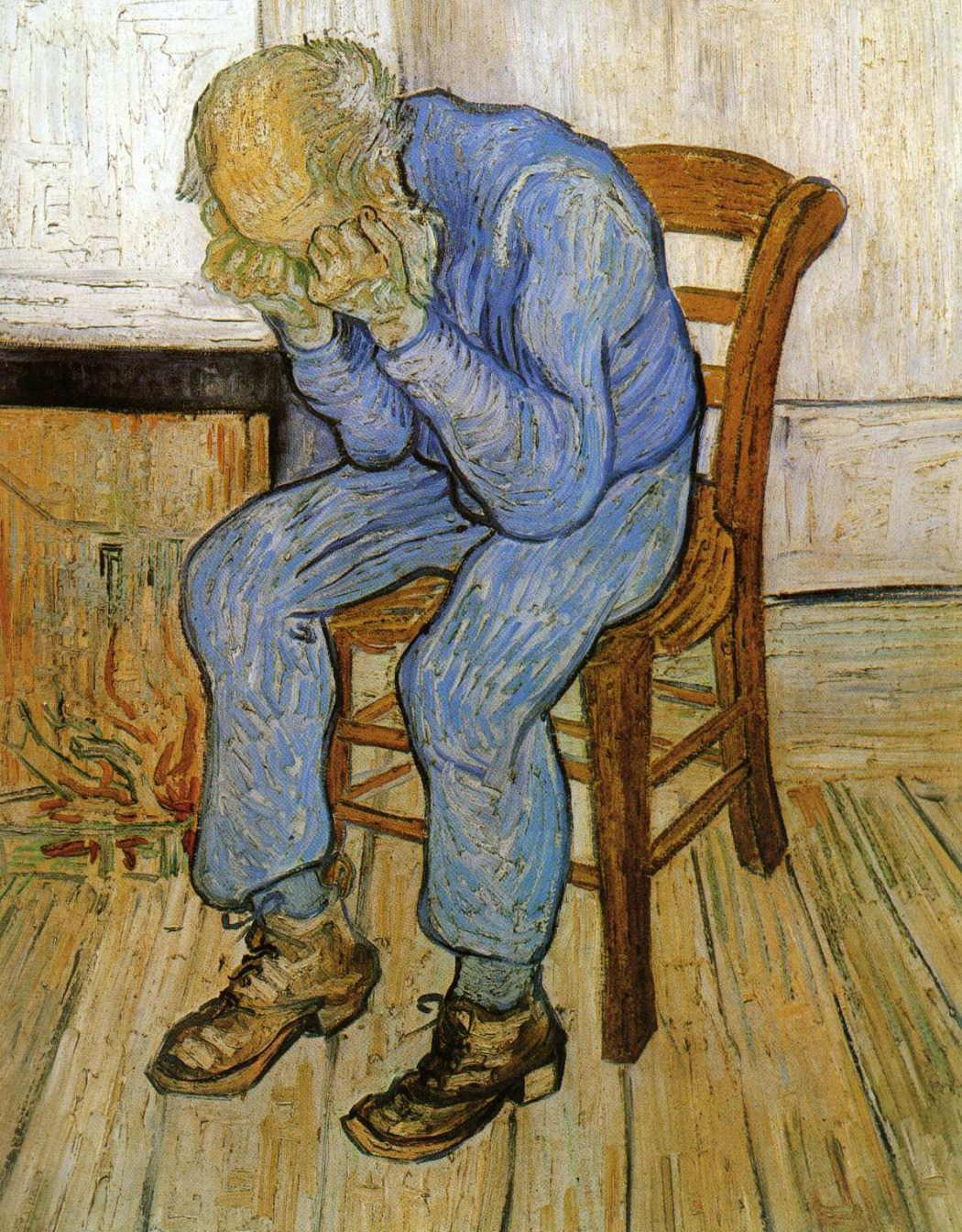
Rugged  textures of the floor, body and chair and elsewhere 
make the pain of Old Man in Sorrow, 1890, seem very real.

Vincent Van Gogh and Edvard Munch had the power to visualize and portray intensity of feelings that most of us humans feel at times, though we might not admit it, or we may not be able to express it.  Van Gogh in the 1880s and Munch in the 1890s experienced a world that was rapidly changing and adjustment would not be easy.  We can understand the difference between old and new life in the very first painting Helene Müller bought.  Paul Gabriël's Train in Landscape, a traditional painting of c.1887,  describes the Dutch world at the time of Van Gogh, one leg in the past and one in the future.

 Paul Gabriël's Train in Landscape, c. 1887, is a traditional, realistic painting of Van Gogh's time.  
A canal divides the painting in center, separating  modern world from old  ways of life. The left has a train and electric wires, while the right side has dikes and windmills representing the past.

I thank Helene Müller for bringing Van Gogh's art to the public.  She also patronized modern artists of her time, such as Picasso, Fernand Leger, Diego Rivera, Dutchmen Piet Mondrian and Bart van der Leck.  She collected many other 19th century modernists: Manet, Monet, Cezanne, Renoir, Pissarro, Gauguin and Munch. In 1922, Helene Muller bought her last painting, Le Chahut by Georges Seurat, a delightful circus image which gives us light-hearteded break from the serious emotions of Van Gogh. 


Le Chahut, 1889-1890, by Georges Seurat, is another masterpiece in the Kröller-Müller Museum.
The humorous facial expressions are a relief  from the intensity of Van Gogh's expressiveness, 
and from the stiffness of  his famous Sunday Afternoon on the Island of .La Grande Jatte.


Since 1977, the museum has added contemporary art and will continue to expand. Not all the famous Van Goghs can be seen at the Kröler-Müller at any one time.  A beautiful example of The Sower owned by the museum was not on view. Today the Kröller-Müller Museum presents Van Gogh in context with other artists, including contemporary artists.  It is in a huge park, once the Kröller property, and there is a wonderful sculpture garden outside.

A sculpture garden in the large park surrounding the Kröller-Müller Museum has a 
playful landscape sculpture by Jean Dubuffet


Sunday, March 18, 2012

Lost Drawings & Paintings Rediscovered

Since 1993, Martin Schongauer's 10" x 13" drawing of Peonies has been in the Getty Museum, Los Angeles. Too fragile for permanent display, it may be in the Getty's exhibition of Renaissance Drawings from Germany and Switzerland, 1470-1600, March 27-June 17, 2012.

A painting of peonies came up for auction in 1990 under the vague label of Northern Italian. However, a museum curator at the Albertina in Vienna recognized it as an important drawing from about 1472-73 by Martin Schongauer, an artist who lived in Alsace on the French-German border. The drawing, now in the Getty Museum, is a study for the flowers in Madonna of the Rosary, 1473, painted by Schongauer for a church in Colmar (now in France). Albrecht Durer traveled to Colmar to visit Schongauer in 1491, but the great Alsatian master had died by the time 21-year old Durer arrived. Martin's brothers met with him and gave him some of the master's drawings. This drawing may have been one of the drawings owned by Durer; the same Viennese curator recognized a flower similar to one of the peonies in a Durer painting of 1501.

In 2007, a pastel drawing came up on the auction market and it was labeled as 19th century German. An astute Canadian collector who bought it had other ideas and sought expert opinion. Most experts now attribute this drawing to Leonardo da Vinci, and it is called La Bella Principessa. The sitter may be the 13-year old daughter of the Duke of Milan, Bianca Sforza. Interestingly, a fingerprint on the paper matches a fingerprint in Leonardo's unfinished painting of St. Jerome. The technique is ink with black, white and red chalk on yellow vellum to give the flesh tones. Leonardo is said to have learned the pastel technique from a French artist.


The circled area of this pastel shows where a fingerprint is found.  It matches the fingerprint on a known painting by Leonardo da Vinci. Also, the left-handed hatching is a signature of Leonardo's style.


A badly damaged painting supposedly by a student of Leonardo sold for 45 British pounds in 1958. Only in the past year has it been cleaned and recognized as an authentic Leonardo da Vinci. Called the Salvator Mundi, it was recently part of an exhibition at the National Gallery in London. In the frontal image, Jesus holds a glass globe and stares directly at the viewer while using the blessed gesture. His calm face is full of compassion and kindness. The penetrating sense of life in this image is clearly palpable, as revealed after its cleaning. It has Leonardo's recognizable sfumato, the smoky quality which gives a dark softness to the shadows. It has the iconic and mysterious qualities reminiscent of as the Mona Lisa. Cleaning revealed this Salvator Mundi to be an authentic
Leonardo da Vinci dating to c. 1500
Martin Kemp, Leonardo expert in England, has identified the rock crystal orb to show the crystalline cosmos in Jesus's hand as something only Leonardo could have painted with accuracy. Leonardo was quite the geologist and Kemp compared the painted example to crystal orbs in the geology collection of the Ashmolean Museum. Therefore, the painting could not have been done by a follower. The last time a painting was discovered to be by Leonardo was 100 years ago.


Only the master Leonardo, who intimately studied nature,
could have portrayed this rock crystal so accurately

Even more remarkable is the fact that a lost painting by Leonardo's young rival, Michelangelo appeared in 2009. This Temptation of St. Anthony is now in the Kimbell Art Museum of Fort Worth. Michelangelo painted this oil and tempera when he was only about 13 years old. The first writer of art history in 1570, Giorgio Vasari described a painting that copied an engraving by Martin Schongauer.

The fact that the two greatest artistic prodigies born in Europe during the 1470s, Albrecht Durer and the divine Michelangelo, admired Martin Schongauer, speaks to that master's incredible reputation as an artist in the 15th century. He died young, but his contribution to later art cannot be overlooked. Although Schongauer's travels probably took him only to the center of Europe: Alsace, Burgundy, Flanders and the Rhineland, his prints gave him a reputation throughout Italy, France, Spain and even England. Italians called him Bel Martino. Perhaps he was born around 1448, a few years before another great observer of nature, Leonardo da Vinci. His drawings inspired the great drawings of nature by Durer, namely The Rabbit and Large Piece of Turf.


Michelangelo's newly discovered Temptation of St. Anthony, c. 1487, copies an engraving by Martin Schongauer

Thursday, March 8, 2012

French "Renaissance" Women of the Revolutionary and Romantic Eras

National Museum for Women in the Arts in Washington, DC, is hosting a ground-breaking exhibition, From Royalists to Romantics: Woman artists from the Louvre, Versailles and other French National Collections. The exhibition celebrates the 25th anniversary of NMWA and will continue to be on view until July 29, 2012. It features 35 woman artists who worked between 1750 and 1850.

The women who worked as artists in France at this time went through difficult times of the Revolution and its aftermath, the governments of Napoleon and Napoleon III and uncertainties in
between. They reveal themselves as extraordinary talents, able to overcome so many odds. Many of those who painted and were the subject of portraits reveal themselves as the Renaissance woman of their days. The cover of the catalogue has an alluring portrait of Madame Juliette Récamier, by Eulalie Morin.

Madame Récamier, by Eulalie Morin, late 18th century, is on the cover of the NMWA ground-breaking exhibition. Morin's Mme Récamier wears a grecian dress and standing in front of an olive tree. Morin used an encaustic technique

Madame Récamier was an extraordinary woman known for holding salons in Paris, hosting notable literary and political figures. She was brilliant, beautiful, charming, witty and politically involved. In time, she was critical of Napoleon, and Madame Récamier went in exile to Italy, but returned to France later. Morin's portrait dates to the last quarter of the 18th century, before the more famous portraits of Madame Récamier by Jacques-Louis David and Francois Gérard. Morin captured the personality of this charming and clever figure and set her in front of a distant landscape. Her skin is soft and smooth, and the flesh tones contrast nicely with the bright white headband and grecian dress. She stands in front of an olive tree, another tribute to Greece and her interest in the ideals of the classical world. The composition is unified with curves of the face, arm, tree and headband to pull it together and focus on the face. Morin's Madame Récamier is intimate and alluring. Perhaps as a result of the NMWA exhibition, Morin's painting will become the iconic image of Madame Recamier, and Eulalie Morin will become better known. (A specific type of couch, a récamier, takes its name from David's portrait of her.)  It's interesting that Morin primarily painted miniatures, the tiny portraits which went out of vogue with the advent of photography.

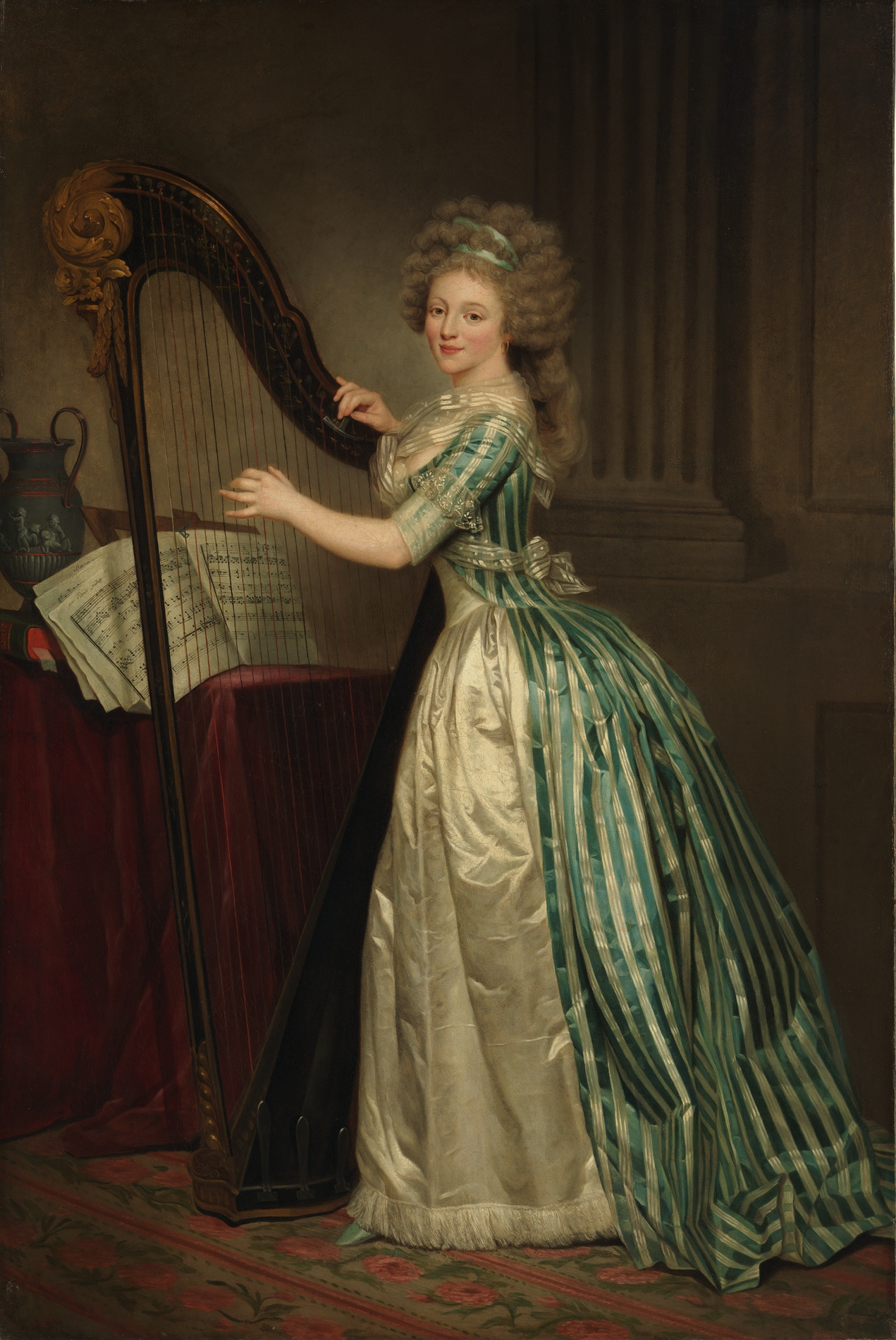
Neoclassical style and the simplicity of white, grecian dress represented sympathy for Republican ideas. A self-portrait of Rose-Adélaïde Ducreux in NMWA's exhibition shows her bending over a painting, demonstrating her art. However, she shined not only as a painter, but as a musician and composer. Her style compares well next to the work of Jacques-Louis David, most revered painter of the age, especially when we see the texture and shine of an exquisite dresses she painted.


A self-portrait of Rose-Adélaïde Ducreux, left, from the Musée des Beaux Arts in Rouen, demonstrates her painting profession.
The current exhibition only features paintings from French museums, but there is a also a full-length self-portrait by Ducreux in the Metropolitan Museum, where she plays the harp. Ducruex was also a musician and composer; this painting, below, was accepted in the Salon of 1791.


Élisabeth Vigée-LeBrun was a prodigy who opened her own painting studio at age 15, supporting her mother and brother. She soon became a favorite of Queen Marie-Antoinette. Marriage and motherhood did not interfere with her career, and she is known for having painted several portraits of herself in affectionate, loving poses with Julie, her daughter.  


Vigée-LeBrun did not support the Revolution and left France, only to gain an international reputation as a portrait painter, particularly amongst the nobility of Austria, Russia and Poland. (A recent blog on her is found here.)

Anne Vallayer-Coster was a marvelous still life painter who was voted into Royal Academy in 1770. A favorite of Marie-Antoinette, she seems to have fallen out of favor after the Revolution. Vallayer-Coster, Vigée-LeBrun and Adélaïde Labille-Guiard, were elected into the exclusive French Academy and achieved fame in their day, but there were many other artists of extraordinary talent whom we now can see and recognize in a new light. Many are portrait painters and some are history painters, the latter considered the highest type of art in its time. A few of them painted genre scenes, still lives or landscapes.

The exhibition's 77 paintings, prints and sculpture mainly come before the invention of photography and do not show its influence. By 1850 the style of Realism had entered the art scene, but the exhibition does not cover this style in which new, younger artists such as Rosa Bonheur were painting. A Legion d'Honneur recipient, Bonheur completed in 1855 her famous The Horse Fair, now in the Metropolitan Museum of Art.


Before the French Revolution, Elisabeth Vigée-LeBrun painted this lively portrait of Joseph Vernet in 1778, primarily using a rich variety of grayish tones. 
Joseph Vernet was a well-known marine painter who frequently portrayed shipwrecks and other disasters.


These works are on loan from France until July 29, 2012, after which they will travel to Sweden.
Constance Mayer, The Dream of Happiness, from the Louvre, has a Romantic mood, popular in the early 19th century. The exact date is unknown